Recycling equipment manufacturerFor a green future
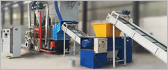
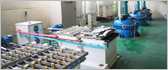
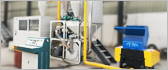
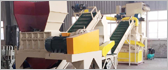


Pharmaceutical blister PVC and aluminum foil recycling equipment is mainly used to process waste blister packs, pharmaceutical packaging materials, and related production scraps. Through mechanical crushing, screening, and sorting, it separates the plastic from the aluminum foil, providing conditions for subsequent material recycling. Equipment configuration should be determined based on the raw material composition, drug residue levels, and target separation effect.
Common pharmaceutical blister packs consist of PVC, PVDC, or other plastic substrates combined with aluminum foil; some packs also use composite film structures. The material type should be identified before recycling, as different plastics and the bonding methods of composite layers will affect the separation effect.
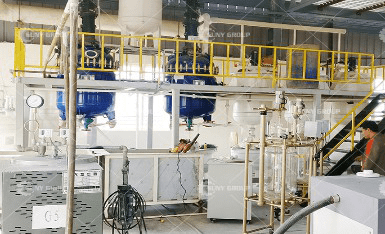
A typical mechanical recycling line consists of a feed conveyor, crusher, fine crushing equipment, vibrating screen, and sorting device. First, the crusher shreds the whole blister pack, forming a smaller mixture of plastic and aluminum foil. Then, further separation and screening reduce adhesion and entanglement between the two materials. Finally, a suitable sorting method is selected based on the particle size, shape, and physical properties of the materials.
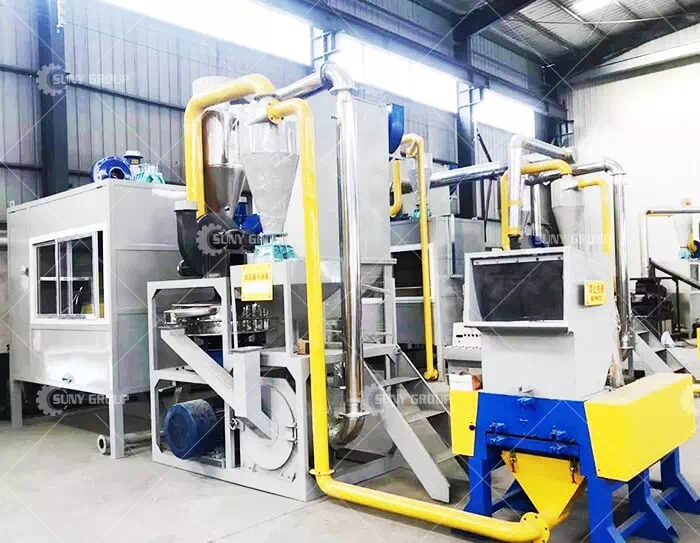
Medicine Blister PVC and Aluminium Recycling Machine
The crusher is responsible for reducing the blister pack to a particle size suitable for subsequent sorting. The cutter structure, rotational speed, screen aperture, and feed rate all affect processing capacity and material morphology. If the particles are too large, the plastic and aluminum foil may still adhere to each other; excessive crushing may generate more fine powder, increasing the difficulty of screening and collection.
Vibrating screens are used for particle size classification, creating conditions for subsequent sorting; air separation, electrostatic separation, or other sorting equipment need to be determined based on the actual material characteristics. It is important to note that the separation of PVC and aluminum foil does not depend solely on the crushed particle size; the bonding strength of the composite layer, moisture content, residues, and the proportion of fine powder also affect the results.
Therefore, equipment acceptance should not only consider the hourly processing capacity but should also simultaneously test the recovery rate of the plastic and aluminum components, the purity of the separated material, dust generation, and continuous operational stability.
Furthermore, when purchasing a Medicine Blister PVC and Aluminium Recycling Machine, it is recommended to provide photos of the raw materials, the main material types, feed dimensions, drug residue levels, and the target processing capacity. If the raw material is primarily PVC aluminum foil blister packs, mechanical crushing and screening methods should be prioritized for evaluation. If it contains multi-layered composite films, paper-plastic mixtures, or complex coatings, sample testing is required first.
A well-configured pharmaceutical blister PVC and aluminum foil recycling line can improve the material sorting efficiency of waste packaging, providing a foundation for the subsequent classification and utilization of plastic and aluminum components.
Thank you for your interest in suny group. If you want to learn more about our E-waste recycling plant, copper wire recycling machine and other machines, Contact us now to find out what we can do for you next project!E-mail:[email protected] | Whatsapp:+8613674945231