Recycling equipment manufacturerFor a green future
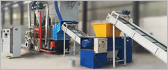
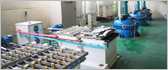
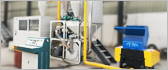
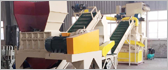


An electronic waste recycling production line is a specialized system of equipment designed to crush, sort, and recover resources from waste circuit boards, computer motherboards, electronic components, and various other forms of electronic waste. It serves as essential infrastructure for the modern e-waste processing industry, enhancing metal recovery rates while reducing manual dismantling costs and enabling the efficient reuse of copper, aluminum, iron, and precious metals.
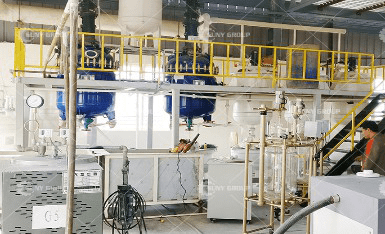
A complete e-waste recycling production line typically comprises a conveying system, crushing equipment, pulverizing equipment, magnetic separators, air separators, electrostatic separators, and a dust collection system. Processing modules can be configured according to the specific characteristics of the raw materials.
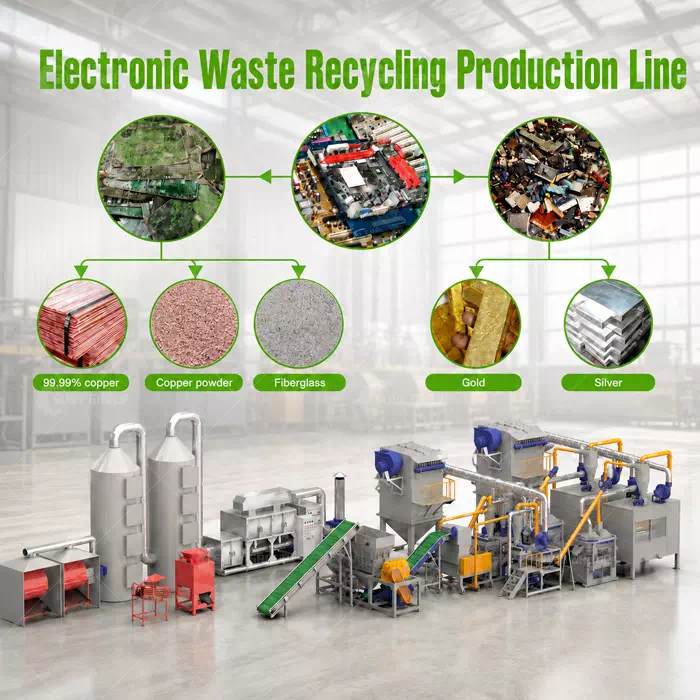
Electronic Waste Recycling Production Line
Upon entering the production line, the material undergoes pretreatment and primary crushing to reduce bulky e-waste into uniform particles. Subsequently, fine crushing and pulverizing systems ensure the thorough liberation of metallic from non-metallic materials. Compared to traditional manual dismantling, mechanized processing allows for continuous operation, significantly boosting processing efficiency and resource recovery rates.
Furthermore, given the complex composition of e-waste, achieving high-quality recovery is difficult with a single piece of equipment. Consequently, modern e-waste recycling lines generally employ a combination of physical separation technologies.
Magnetic separators are primarily used to recover ferromagnetic metals; air separators utilize density differences to separate lightweight non-metallic materials; and electrostatic separation systems further segregate metals—such as copper and aluminum—from resin powder based on differences in electrical conductivity. Following multi-stage separation, high-purity metal products and non-metallic materials are obtained.
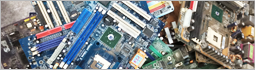
Take waste PCBs, for instance: their copper content typically ranges from 15% to 30%, with some high-value boards containing even higher concentrations. Proper configuration of crushing and sorting equipment effectively maximizes metal recovery and minimizes resource waste. Additionally, enclosed dust collection systems capture dust generated during production, thereby improving the working environment and ensuring compliance with environmental regulations.
As the global turnover rate of electronic products accelerates, the volume of e-waste continues to rise. Traditional manual dismantling methods struggle to meet the demands of large-scale processing; in contrast, automated e-waste recycling lines enable continuous feeding, automatic sorting, and centralized collection, drastically reducing labor costs. By employing advanced equipment for crushing, sorting, and environmentally friendly processing, electronic waste recycling production lines not only enhance resource utilization efficiency but also mitigate the environmental impact of e-waste, providing a stable and sustainable solution for the renewable resource industry.
Thank you for your interest in suny group. If you want to learn more about our E-waste recycling plant, copper wire recycling machine and other machines, Contact us now to find out what we can do for you next project!E-mail:[email protected] | Whatsapp:+8613674945231