Recycling equipment manufacturerFor a green future
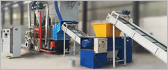
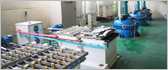
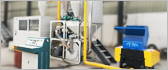
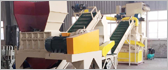


An e-waste recycling production line is a comprehensive system designed for the dismantling, shredding, sorting, and resource recovery of electronic waste—including discarded computers, mobile phones, circuit boards, and home appliances. Its primary function is to effectively separate valuable materials such as copper, aluminum, iron, plastics, and precious metals from discarded electronic products, thereby enhancing resource utilization while simultaneously minimizing environmental pollution and the safety risks associated with manual handling.
Core Components of an E-Waste Recycling Production Line
A complete e-waste recycling system typically comprises a conveying system, a shredding system, a magnetic separation system, an airflow sorting system, and an environmental dust removal system. The specific configuration of these components can be customized based on the type of materials being processed and the specific recycling requirements.
The process begins with a dual-shaft shredder or coarse crushing equipment, primarily used to process large-scale electronic waste such as computer casings, circuit boards, and discarded home appliances. Utilizing a low-speed, high-torque design, this equipment shreds the materials down to a size suitable for subsequent processing stages.
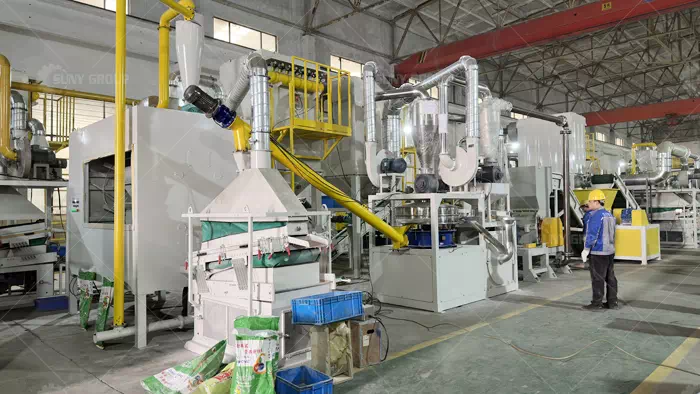
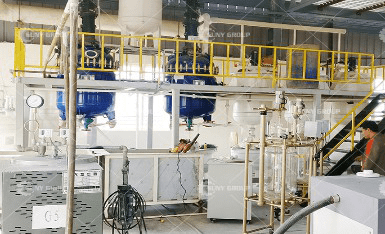
E-Waste Recycling and Processing Plant
Next, the materials proceed to a fine shredder and pulverizing system, where they undergo further size reduction to enhance the separation efficiency between metallic and non-metallic components. For high-value materials—such as circuit boards—the precision of this pulverizing stage directly impacts the subsequent separation efficiency of copper powder and resin powder.
During the sorting phase, magnetic separators are employed to extract ferrous metals, while airflow sorting and electrostatic separation equipment are utilized to separate materials of varying densities—such as copper, aluminum, and plastics—thereby increasing the purity of the recovered materials.
Operational Features and Environmental Advantages
Modern e-waste recycling equipment places a strong emphasis on automation and environmental performance. The entire production line operates continuously, minimizing the need for manual intervention and enhancing production stability.
Furthermore, these systems are typically equipped with pulse dust removal systems and exhaust gas filtration devices, which effectively control dust pollution during the shredding and sorting processes, thereby improving the working environment within the facility. Some high-specification production lines also incorporate PLC-based intelligent control systems to enable automated monitoring and fault diagnostics, thereby reducing equipment maintenance costs.
For recycling enterprises, stable equipment operation is critical; it not only determines production output but also directly impacts the metal recovery rate and long-term operational costs.
The Growing Value of the E-Waste Recycling Industry
As the volume of discarded electronic products continues to rise, the e-waste recycling industry is evolving toward greater scale and sophistication. Compared to traditional manual dismantling methods, automated e-waste recycling production lines offer distinct advantages in terms of efficiency, safety, and resource recovery rates. For enterprises seeking to enter the electronic waste recycling industry, selecting an equipment configuration tailored to their specific processing capacity and material types is a critical step in maximizing recycling efficiency and controlling investment costs. A well-conceived equipment plan not only enhances the value of recovered metals but also aligns more closely with current trends in environmental protection and resource recycling.
Thank you for your interest in suny group. If you want to learn more about our E-waste recycling plant, copper wire recycling machine and other machines, Contact us now to find out what we can do for you next project!E-mail:[email protected] | Whatsapp:+8613674945231