Recycling equipment manufacturerFor a green future
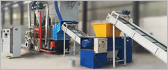
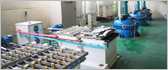
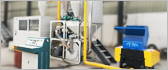
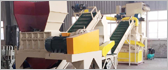
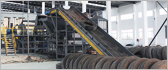


A waste tire crushing and recycling production line is, in essence, an automated equipment system designed to transform difficult-to-process waste tires into reusable rubber granules, steel wire, and fiber materials through a series of processes—including crushing, steel wire separation, fiber sorting, and rubber granule screening. This system not only addresses the environmental issues associated with accumulated tire waste but also facilitates the re-entry of recycled rubber into various industrial supply chains, such as those for running track materials, reclaimed rubber, and rubber floor tiles.
What Equipment Constitutes a Tire Crushing and Recycling Production Line?
A complete tire recycling production line typically comprises a tire bead cutter, a tire shredder, a steel wire separator, a rubber granulator, magnetic separation equipment, a fiber separation system, and a screening system.
Among these components, the dual-shaft shredder serves as one of the core pieces of equipment in the entire line. Since automotive tires contain a significant amount of internal steel wire reinforcement, standard crushing equipment is prone to severe blade wear. Consequently, industrial tire shredders typically utilize high-hardness alloy blades and feature a low-speed, high-torque structural design to enhance equipment stability and durability. For larger-diameter engineering tires (such as those used in heavy machinery), many production lines also incorporate pre-cutting equipment to reduce the operational load on downstream machinery.
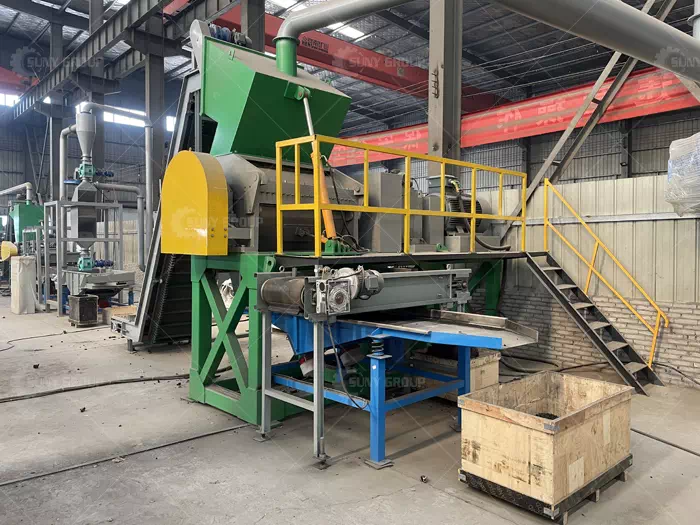
Tire Crushing and Recycling Production Line
The magnetic separation system plays a decisive role in determining the purity of the recovered steel wire. In actual production, the steel content within tires typically accounts for approximately 15% of the total weight; if separation is incomplete, it not only compromises the quality of the rubber granules but also accelerates wear and tear on subsequent processing equipment. Therefore, configurations featuring high-intensity magnetic rollers and multi-stage magnetic separation structures have become the industry standard.
Which Key Stages Determine the Quality of Rubber Granules?
Many people assume that the primary focus of tire recycling lies in the "crushing" phase; however, the factor that truly determines the value of the final product is often the downstream, fine-sorting process.
For instance, the equipment requirements for producing 3–5 mm rubber granules differ entirely from those for producing rubber powder finer than 30 mesh. The finer the desired granule size, the higher the demands placed on the precision of fiber separation, the stability of the air classification system, and the accuracy of the screening process. While some lower-specification equipment may be capable of performing the initial crushing, it often leaves a significant amount of residual fiber within the rubber—a factor that directly compromises the quality of the resulting reclaimed rubber products.
Furthermore, temperature control within the equipment is a critical factor. During the high-speed pulverization of tires, heat is inevitably generated; if the internal temperature becomes excessive, the rubber material can become sticky and agglomerate, thereby disrupting the uniformity of the output flow. Consequently, some production lines incorporate circulating air-cooling systems or specialized low-temperature pulverization structures to enhance the equipment's capacity for continuous, uninterrupted operation. Tire Recycling Equipment Is Evolving Toward Automation and Precision
Currently, the tire recycling industry is shifting from "extensive processing" to "high-value-added recovery." In the past, many facilities merely produced coarse rubber blocks; however, the market now places a greater focus on high-purity rubber powder, fine granules, and consistent steel wire recovery rates.
This also implies that the future competitive landscape for tire shredding and recycling production lines will no longer center solely on processing throughput, but rather on the degree of automation, energy consumption control, cutter tool longevity, and the purity of the finished products. For equipment manufacturers, the ability to minimize maintenance frequency and enhance operational stability will prove far more critical than the mere pursuit of low pricing.
Thank you for your interest in suny group. If you want to learn more about our E-waste recycling plant, copper wire recycling machine and other machines, Contact us now to find out what we can do for you next project!E-mail:[email protected] | Whatsapp:+8613674945231